
New GMAT Feature Allows Students To Choose The Order Of Sections; www.gmac.com
Latest update: Please note that this article was written on an earlier date when GMAC had introduced this particular feature for aspirants wanting to appear for their GMAT exam.
In a continuing effort to enhance the GMAT exam experience for test takers, the Graduate Management Admission Council (GMAC) announced the upcoming launch of Select Section Order, a new feature that will provide candidates the flexibility to customize their GMAT experience by choosing the section order in which they feel most comfortable taking the exam. Select Section Order will be available to test takers worldwide beginning July 11, 2017.
| About GMAT Exam | GMAT Registration |
| GMAT Exam Dates | GMAT Syllabus |
| GMAT Scores | GMAT Preparation Tips |
“The idea of being allowed to choose the section order had been commonly requested by test takers,” said Ashok Sarathy, Vice President, Product Management, GMAC. “We conducted a pilot in 2016 to test this feature and received overwhelmingly positive feedback, with 85 percent of participants surveyed expressing that this new feature boosted their confidence prior to even taking the exam. Our pilot findings also concluded that taking the exam in different section orders continues to maintain the quality and integrity of the GMAT scores.”
Related post
The GMAT has four sections. When implemented on July 11, test takers will select their desired section order at the test center on exam date, immediately prior to the start of the exam. Test takers will be able to choose from three options:
- Analytical Writing Assessment, Integrated Reasoning, Quantitative, Verbal (original order);
- Verbal, Quantitative, Integrated Reasoning, Analytical Writing Assessment; or
- Quantitative, Verbal, Integrated Reasoning, Analytical Writing Assessment.
These new changes are a continuation of the steps GMAC has implemented in recent years to enhance the test takers’ GMAT experience, including:
- the ability to cancel scores online after leaving the test center and the enhanced score reinstatement policies (March 2016),
- removing canceled scores from school score reports
- allowing candidates to retake the GMAT exam after a 16-day time period rather than the previous 31-day retake period, and enabling test takers to access their Official Score Report online using their date of birth instead of an authentication code (July 2015),
- the introduction of the GMAT Enhanced Score Report, which provides test takers access to an in-depth analysis of their overall GMAT performance (January 2015), and
- the introduction of GMAT Score Preview, enabling test takers to preview their unofficial scores before deciding whether to report or cancel them (July 2014).
“The GMAT exam shows business schools that the test taker is serious about earning a graduate business degree and demonstrates the individual’s commitment and readiness for the rigors of a graduate business program,” said Sarathy. “Today, 9 out of 10 new MBA enrollments at the top 50 U.S. full-time MBA programs are made using a GMAT score.”
Mastering Your Exam Strategy: The GMAT’s Flexible Section Order
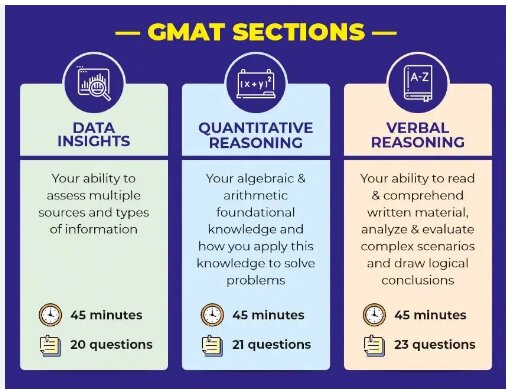
In the evolution of standardized testing, the GMAT has transitioned from a rigid, high-pressure experience into a more personalized journey. One of the most significant features for modern test-takers is the ability to select the order of the exam’s three sections. This design choice acknowledges that every candidate approaches problem-solving differently, allowing you to tailor your test-day environment to your specific mental strengths and energy levels.
What Does “Flexible Section Order” Mean?
On the day of your GMAT, before you begin the first question, you are prompted to choose your preferred sequence for the three core sections:
-
Quantitative Reasoning
-
Verbal Reasoning
-
Data Insights
Once you select your desired order and begin the exam, that sequence is locked in. You are required to complete all three sections, and you cannot revisit or retake a section once it is finished. If you do not make a selection within the allotted one-minute window, the system will automatically assign an order for you.
Why This Flexibility Matters
The GMAT is an exercise in mental endurance. By allowing you to choose your own path, the exam empowers you to manage your “cognitive load” more effectively.
-
Bank Your Confidence: Many students prefer to start with their strongest subject. By tackling a section where they excel first, they build momentum and confidence that carries them through the more challenging parts of the test.
-
Manage Energy Levels: Some test-takers find that their focus wanes as the clock ticks down. Starting with the most mentally taxing section ensures you are at your peak when facing your most difficult material.
-
Strategic Personalization: If you know that a particular section—such as Data Insights—requires a high degree of alertness, you can schedule it for the “fresh” part of your testing experience rather than leaving it for the very end.
Strategic Considerations: Choosing Your Order
There is no “perfect” order for every student; the right choice is entirely dependent on your personal preparation and psychological profile.
1. The “Strength-First” Approach
-
Logic: Start with your highest-performing section.
-
Benefit: This creates a positive feedback loop, reducing test anxiety early on.
-
Best for: Students who suffer from test-day nerves and need a “win” early in the session.
2. The “Weakness-First” Approach
-
Logic: Tackle your most difficult section while your brain is fresh.
-
Benefit: You avoid the risk of having to face your most feared material when you are already mentally fatigued.
-
Best for: Students who find it difficult to maintain concentration or who experience significant mid-test burnout.
3. The “Sandwich” Strategy
-
Logic: Place your most comfortable section in the middle, between your two most challenging ones.
-
Benefit: This allows you to use your strongest area as a “breather” or a mental reset, providing a buffer between two high-intensity sections.
Complementary Features for a Better Experience
The ability to choose your section order is part of a broader suite of “test-taker-friendly” features that define the modern GMAT experience:
-
Question Review & Edit: You can now bookmark questions as you go. Once you reach the end of a section, you have the opportunity to review those bookmarked items and change up to three answers before submitting the section.
-
Flexible Breaks: You have the autonomy to decide when to take your optional 10-minute break—either after the first section or after the second. This choice, combined with your section order, gives you total control over the flow of your exam.
Pro-Tips for Your Practice
-
Experiment Early: Use your official practice exams to test different orders. Do not wait until the actual test day to discover that a specific sequence makes you feel more anxious or tired.
-
Simulate the Conditions: When taking practice tests, ensure you are using the same timing and break structure you intend to use on the real exam.
-
Don’t Overthink It: While strategy is important, remember that the content of the GMAT remains the same regardless of the order you choose. A well-prepared student will perform strongly regardless of the sequence.
By utilizing these customizable features, you can approach the GMAT not as a rigid obstacle, but as a structured challenge that you have the tools to master on your own terms.